
How do you make it work in Car? : A Practitioner’s Take on Adaptive PID Control

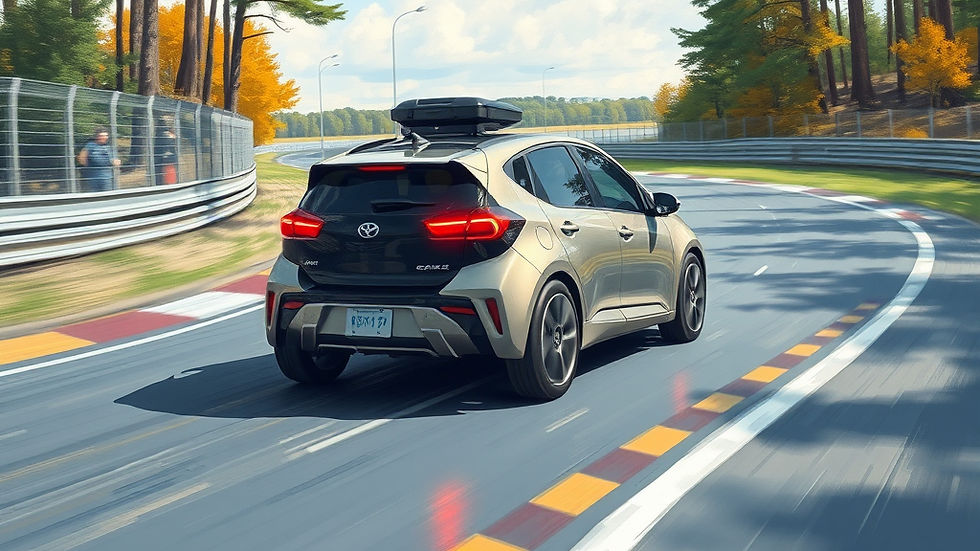
In the high fidelity Automotive Simulation environment, algorithms like Model Reference Adaptive Control (MRAC) or Reinforcement Learning (RL) work with deceptive ease. The question every Automotive Professional / Architect faces is "How will you make this work in car?". While the car learns to drift with mathematical perfection in the GUI world, a whole new plethora of issues will turn up when you want to make a 2000kg machine drive on a real track.
There is a reason why the PID control still survives in the rapid age of LLM, AI. It's a simple and straight forward control algorithm. This framework has existed nearly for a century and is nearly dominant. We intentionally keep the cars control engineering dumb. Because in a high-stakes engineering field, a predictable, statically analyzable system is more valuable than an evolving one that might not be transparent or traceable.
Takeaway 1: The Myth of a "Clean" signal
In a simulator, a controller enjoys a perfect state information. It knows Lateral Position Error, the side slip angle, and the tire friction coefficient down to third or fourth decimal. But in the real world these signals have to be estimated from a noisy observer. The sensors often have measurement jitter.
So, the Software V1's usually stick to Kinematic Bicycle model which will soon need vehicle dynamics improvements. The tuning can't be done in the order of hours as we do in the simulator, it can take multiple hours to days. The cases from which engineers or the models learn aren't usually seen in the typical highway driving data. The signal preprocessing from real world data itself adds to weeks of Algorithm and vehicle testing work.
Reflection
When the controller is fed a guess instead of ground truth, it achieves "mathematical convergence" without "physical meaning". It might find a set of gains that perfectly minimise the error metric on paper, but those gains could cause "parameter chatter" that can physically destroy the hardware or worse may make us feel like the engineering progress is going no where while the learnt performance is an underestimated and under represented.
Takeaway 2: The Unseen (Time Delays and Latency)
Simulation often under-represents latency, jitter, and scheduling effects, but the real car needs intense system integration focus. When an adaptie law based on RL/ Backpropogation based PID/ Fuzzy Logic Layer proposes gain change, it faces a world of unmodeled dynamics.
Hydraulic Lag: The time for brake fluid to reach calipers.
Network Jitter: The milliseconds of delay as messages wait for prioritization on a crowded CAN.
ECE Processing Intervals: The strict timecycles of safety certified microcontroller.
Many adaptive frameworks assume instantaneous effect. In reality, these delays introduce phase lags. An aggressive update that's supposed to come a 100ms ago is delayed and leaves its residual effects. By that time controller with ramped up gain already overshoots.
Takeaway 3: Why ISO 26262 is the Ultimate gatekeeper
In Automotive Engineering, the most important lesson I learnt in the early stages of my career is, performance is always secondary to safety. ISO 26262 is the go-to standard that requires us to prove that a controller is deterministic. A Self-Tuned Regulator that evolves or changes its behavior online is a Certification Engineer's worst nightmare.
The industry till now would rather have a "conservatively tuned" fixed PID that's slightly suboptimal than an "Optimal" RL algorithm that might decided on an untested behaviour in a crisis.
Reflection
Manufacturers must consider the years of maintanence a vehicle requires. Long after the original developers have left the company, a simple PID is troubleshootable by a field technician. A complex RL algorithm that demands specific reward corrections or a Neuro-Fuzzy logic system that's complex and evolving is essentially unmaintainable.
Takeaway 4: The Danger of Unsafe Exploration
In a simulator the car can crash a thousand times, but there is a real const of a "trial and error" catastrophic. The engineering days in a project are numbered hence testing has to be efficient and measured. Learning algorithms which are fundamentally exploratory, test the boundaries of a cost function. This limits us to never test the online exploration route of Adaptive Algorithms.
Takeaway 5: The Belt and Suspenders route
To bridge the gap between AI and safety, most of the adaptive control algorithms online take belt and suspenders approach. There is an intelligent layer and a safety layer clearly seperated.
The Feedforward Path: We use sophisticated models or AI-trained maps to provide a "base guess" of the required control signal. This handles the complex, non-linear physics part.
The Feedback Path: A simple, deteministic PID handles the residual error.
This ensures a saturation limit placed on bad guess and the control logic remains predictable. We use AI offline to find best tuning parameters during development, but we "freeze" them in a lookup table just like some of the genetic algorithm approaches have taken the route of. The risk of unexplored environments still exists here. But this approach beats a complex and opaque models.
My take:
There is a saying that "We can't improve what we can't measure", so the improvement of the irregularities should be measured on-device based on the sensor inputs that we received. This should be intuitive and straight forward.
This mandates the understanding of real-world engineering issues and making it as a design choice of novel approaches that are being developed. The core conflict that I want to highlight with this article is the gap between mathematical elegance of many of the available Adaptive PID approaches and the Physical robustness. We are moving towards more intelligent vehicles, by not giving them a free brain, instead we give them a "bounded adaptation".
In the realworld obsessed with AI Autonomy, the most intelligent move is knowing how to move the algorithms from papers to testing track. The goal isn't a ca that learns everything, but one that understands the reality it's in and still achieves an optimal decision making.
References
Åström, K. J., & Hägglund, T. (2000). Supervision of adaptive control algorithms. Automatica : Discusses supervisory and fallback mechanisms required to ensure stability in adaptive controllers.
Lee et al. (2023). Adaptive PID control for autonomous driving. : Reports degradation in performance and stability under sensor noise and time delays in real-world implementations.
Martini et al. (2023). Hybrid control approaches for autonomous drifting : Highlights verification challenges of end-to-end learning systems and their incompatibility with ISO 26262 safety requirements.
Zuo et al. (2025). Safe reinforcement learning for autonomous driving : Identifies unsafe exploration and sim-to-real gaps as key barriers to deploying standard RL methods in real vehicles.
Zhao et al. (2020). MRAC-based adaptive braking control : Notes that critical factors such as road friction are not directly measurable and require observer-based estimation.

Comments